Topology Optimization with Accessibility Constraint for Multi-Axis Machining
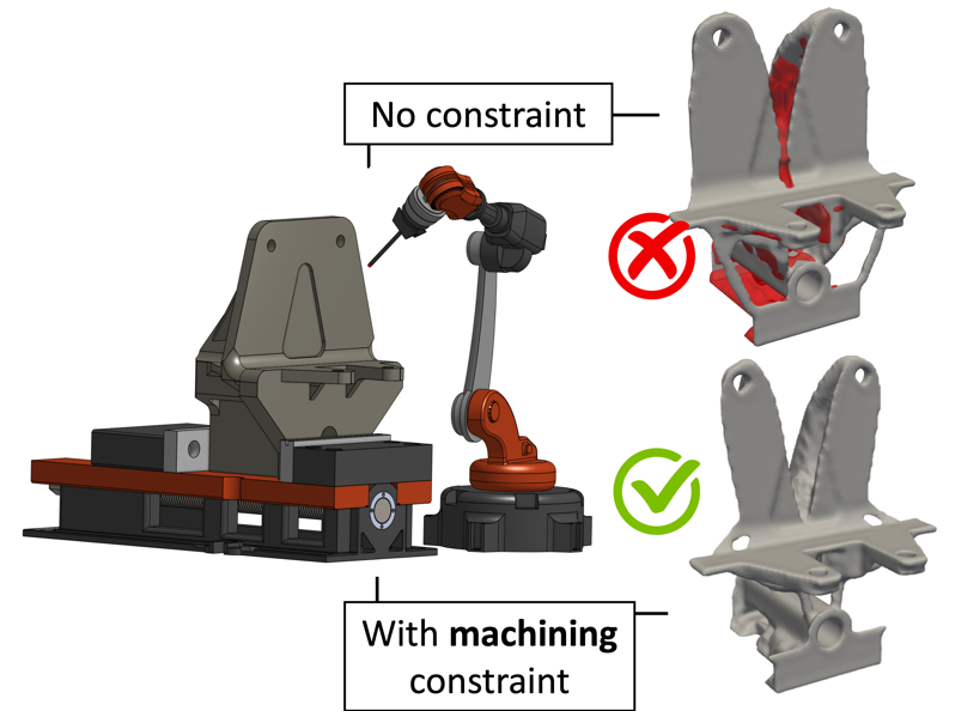
A generic approach to incorporate accessibility constraints for multi-axis machining into the design optimization process. The inputs are the shapes of initial design (e.g., the brackets shown above), stationary obstacles such as fixtures, moving objects including the entire tool assembly, and the available orientations. The output is an optimized design that is guaranteed to be accessible everywhere in the negative space of the part in at least one configuration and the set of all such configurations at the desired sampling resolution. The examples are demonstrative of arbitrary geometric complexity, and do not correspond to real industrial setups (Mirzendehdel et al., 2020), .
Concepts and overall Approach.
Machining cutting tool and regions.
0° Configuration
180° Configuration
0° + 180° Configuration
45° Configuration
Benchmark cantilever beam example in 2D at a volume fraction of 0.5. The accessibility constraint is imposed at 4 different configurations.
Demo video for three-axis machining with VISE fixture and GE bracket under two load cases.
References
2020
Journal (CAD)
Topology optimization with accessibility constraint for multi-axis machining
Amir M. Mirzendehdel, Morad Behandish, and Saigopal Nelaturi
Computer-Aided Design, 2020
Special Issue on Process Planning for Additive/Hybrid Manufacturing
In this paper, we present a topology optimization (TO) framework to enable automated design of mechanical components while ensuring the result can be manufactured using multi-axis machining. Although TO improves the part’s performance, the as-designed model is often geometrically too complex to be machined and the as-manufactured model can significantly vary due to machining constraints that are not accounted for during TO. In other words, many of the optimized design features cannot be accessed by a machine tool without colliding with the part (or fixtures). The subsequent post-processing to make the part machinable with the given setup requires trial-and-error without guarantees on preserving the optimized performance. Our proposed approach is based on the well-established accessibility analysis formulation using convolutions in configuration space that is extensively used in spatial planning and robotics. We define an inaccessibility measure field (IMF) over the design domain to identify non-manufacturable features and quantify their contribution to non-manufacturability. The IMF is used to penalize the sensitivity field of performance objectives and constraints to prevent formation of inaccessible regions. Unlike existing discrete formulations, our IMF provides a continuous spatial field that is desirable for TO convergence. Our approach applies to arbitrary geometric complexity of the part, tools, and fixtures, and is highly parallelizable on multi-core architecture. We demonstrate the effectiveness of our framework on benchmark and realistic examples in 2D and 3D. We also show that it is possible to directly construct manufacturing plans for the optimized designs based on the accessibility information.


 Topology optimization with accessibility constraint for multi-axis machiningComputer-Aided Design, 2020
